Invasive ant colonies in Southwest Florida rarely maintain a single central nest. Species such as the ghost ant and tawny crazy ant form dispersed satellite colonies across tree canopies, moist landscaping beds, and…
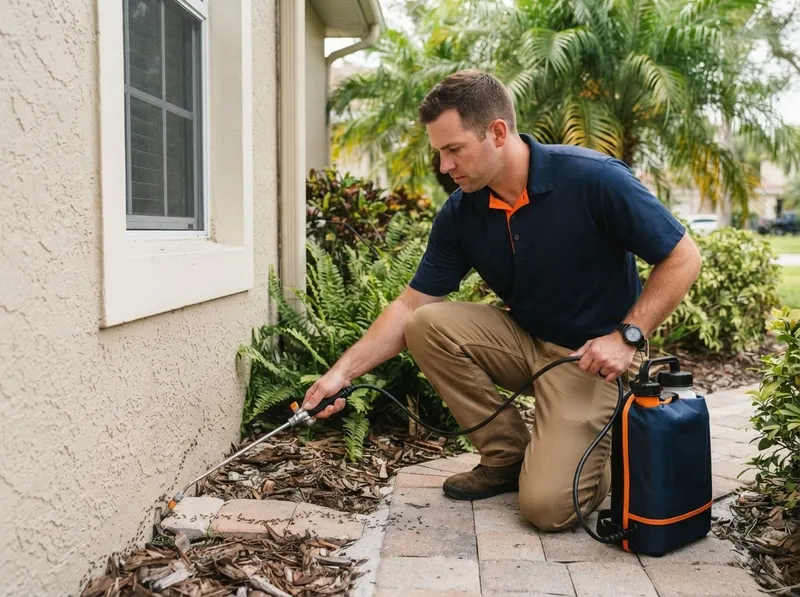
Invasive ant colonies in Southwest Florida rarely maintain a single central nest. Species such as the ghost ant and tawny crazy ant form dispersed satellite colonies across tree canopies, moist landscaping beds, and wall cavities. Over-the-counter repellant sprays scatter these multi-queen colonies, a biological reaction known as budding, multiplying a single entry point into several indoor trails. Professional eradication utilizes non-repellent active ingredients and slow-acting matrix baits. Worker ants transfer these undetectable agents through trophallaxis to hidden queens and developing larvae, neutralizing the colony within 7 to 21 days rather than merely repelling surface foragers.
Soil types and environmental moisture patterns heavily govern ant nesting behavior throughout Lee County. Waterfront properties near the Caloosahatchee River along McGregor Boulevard and low-lying soils in Iona or San Carlos Park experience rapid groundwater shifts after summer afternoon deluges. Heavy saturated turf drives subterranean colonies upward into weep screeds, window sills, and sub-slab plumbing penetrations. Inland developments such as Gateway, Botanica Lakes, Paseo, and Pelican Preserve frequently feature dense sod, decorative mulch rings, and retention pond borders that harbor dense populations of red imported fire ants and big-headed ants. Establishing a resilient protective perimeter requires treating both the structure's physical transition points and the adjacent nesting substrate.
Selecting between spot exterior broadcast treatments and whole-structure perimeter voids depends directly on species behavior and structural vulnerability. If ghost ants show in indoor kitchens or bathrooms, interior void baiting paired with window frame applications prevents interior foraging; if crazy ants overrun turf and electrical boxes, deep turf drenching and wide property-line barriers are required. Non-repellent liquid barriers require undisturbed placement, meaning lawn edging and intense irrigation schedules must be adjusted for 48 hours following service. This service focuses on eliminating active root-zone colonies rather than simple surface knockdown, delivering durable structural defense against Lee County's continuous insect pressure.
Every job gets a firm, written price after a free on-site visit.
Tell us about your invasive ant colony elimination job in Fort Myers and we'll send a clear, written quote, usually the same day.
 Blue Timber Pest Control