Paper wasp activity in Southwest Florida spikes sharply following tropical storm systems and sustained humidity increases above 80 percent. The local environment sustains multiple aggressive species, predominantly the…
Paper wasp activity in Southwest Florida spikes sharply following tropical storm systems and sustained humidity increases above 80 percent. The local environment sustains multiple aggressive species, predominantly the red paper wasp (Polistes rubiginosus) and the brown paper wasp (Polistes bellicosus). These insects construct open, umbrella-shaped hexagonal comb nests using weathered wood fibers mixed with saliva. In residential areas along the Caloosahatchee River corridor, including Whiskey Creek and the Dean Park Historic District, wasps exploit open fascia gaps, decorative corbels, historic soffit vents, and patio overhangs. In inland developments such as Gateway, Botanica Lakes, and Pelican Preserve, covered lanais, pool cages, and under-eave light fixtures serve as prime harborage zones. Unlike single-queen honeybees, a single large structure can harbor dozens of distinct paper wasp colonies simultaneously, generating immediate puncture and envenomation hazards for property owners walking out back doors or operating pool screen doors.
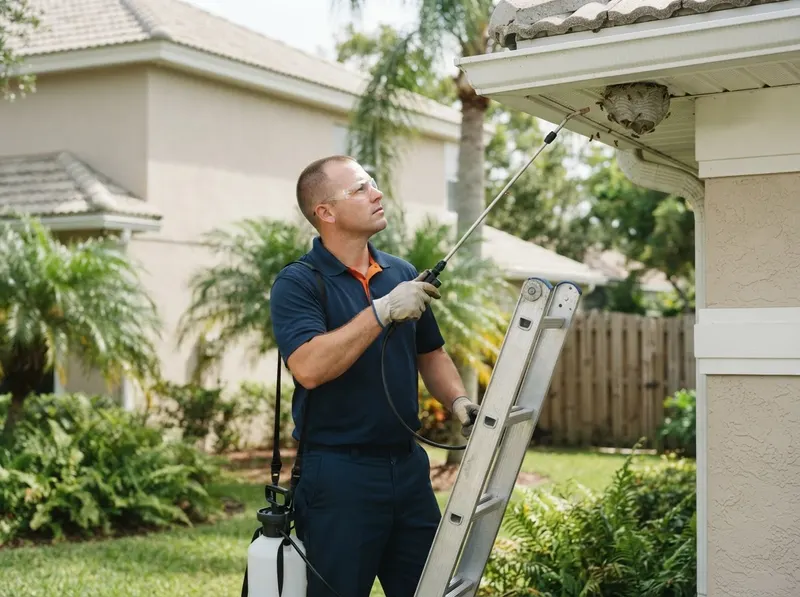
Store-bought perimeter sprays feature aerosol formulations that disperse rapidly in subtropical heat and only agitate aerial workers, which frequently drops active stinging insects onto the applicator. Professional abatement deploys microencapsulated pyrethroid compounds and targeted non-repellent formulations direct into the comb architecture using telescopic extension poles up to 30 feet tall. The chemical formulation penetrates the brood cells, neutralizing pupae, larvae, and returning foraging adults. Once knocked down, technicians physically detach the paper comb from the substrate using rigid scraping implements. Crucially, the surface attachment pad is scrubbed down; wasps rely on orientation pheromones left on substrate pedicels to reconstruct colonies on the exact same corner if not eradicated. Technicians then apply a concentrated wettable powder barrier that adheres to concrete tile, stucco, and wood-trim profiles, preventing prospective queens from establishing new starter combs for up to 90 days.
Property owners must evaluate the operational trade-off between isolated spot-spraying and comprehensive perimeter exclusion. An individual spot-clear addresses a single active comb visible over an entry door, costing the baseline $250 fee, but leaves adjacent soffits open to recolonization within 14 days during peak swarming months. A full-perimeter abatement program secures every side of the building, detached garage, lanai frame, and outdoor shed, creating continuous chemical coverage at higher material usage. Properties bordering natural wetlands or stormwater preserves, common throughout Paseo, Iona, and San Carlos Park, face sustained ambient pest pressure from open water reservoirs and native saw palmettos. Selecting perimeter-wide defense stops foraging wasps from establishing entry points behind barrel tiles or deep within attic insulation, preserving the physical perimeter without locking the property owner into multi-year cancellation agreements.
Every job gets a firm, written price after a free on-site visit.
Tell us about your stinging insect and paper wasp abatement job in Fort Myers and we'll send a clear, written quote, usually the same day.
 Blue Timber Pest Control